Selecting the right hydraulic pump is critical for system efficiency, reliability and long service life. A wrong pump selection can lead to pressure loss, overheating, noise, frequent breakdowns and high maintenance cost.
This guide explains how to choose the correct hydraulic pump for industrial applications based on technical parameters, operating conditions and real-world usage.
Why Hydraulic Pump Selection Matters
The hydraulic pump is the heart of any hydraulic system. It converts mechanical energy into hydraulic energy by generating flow. If the pump does not match the system requirement, the entire machine performance suffers.
Correct pump selection helps you achieve:
- Stable pressure and flow
- Lower energy consumption
- Reduced oil heating
- Longer component life
- Lower maintenance downtime
Step 1: Understand the Application Requirement
Before selecting a pump, clearly define the application.
Ask these questions:
- What type of machine is it?
- Is the system continuous duty or intermittent?
- Does the application require precise control or high force?
- Is noise level a concern?
- Is it an industrial plant or mobile equipment?
Examples:
- Injection moulding machines require stable flow and low noise.
- Press machines require high pressure and fast response.
- Machine tools require smooth and precise flow control.
Step 2: Determine Required Flow Rate
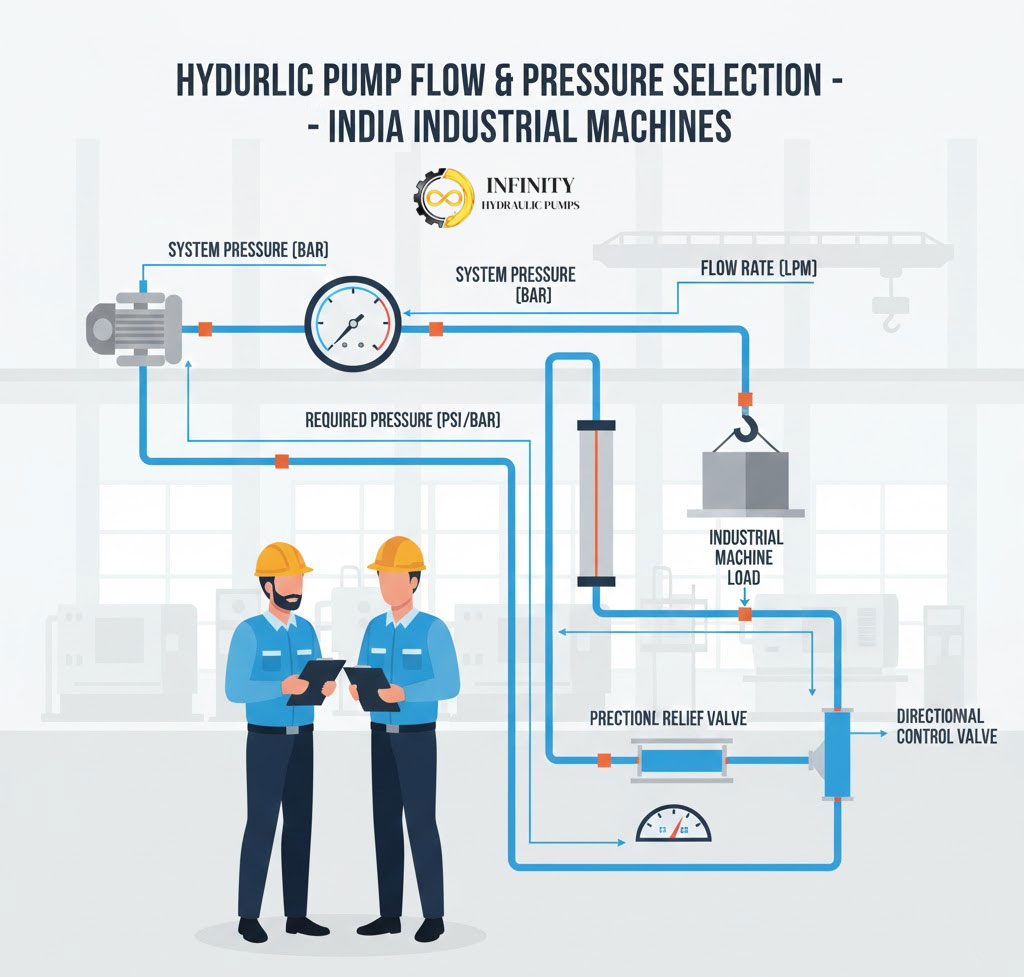
Flow rate decides the speed of actuators like cylinders and motors.
Flow depends on:
- Cylinder bore and stroke
- Desired cycle time
- Number of actuators operating together
Flow is usually expressed in:
- LPM (Litres per Minute)
- GPM (Gallons per Minute)
Selecting a pump with insufficient flow causes slow operation. Oversized flow increases heat and power loss.
Step 3: Determine Operating Pressure
Pressure is required to generate force.
Operating pressure depends on:
- Load to be lifted or moved
- Cylinder area
- Machine resistance
Always consider:
- Maximum system pressure
- Continuous operating pressure
- Safety margin
The pump must comfortably operate within the required pressure range without excessive wear.
Step 4: Choose the Right Pump Type
Vane Pumps
- Suitable for medium pressure systems
- Low noise operation
- Used in machine tools, power packs and automation
- Ideal for clean oil and continuous duty
Piston Pumps
- Suitable for high pressure applications
- Available in fixed and variable displacement
- Used in presses, injection moulding and heavy machinery
- High efficiency and long life
Gear Pumps
- Simple and compact design
- Used in mobile equipment and basic industrial systems
- Cost-effective and easy to maintain
- Suitable for moderate pressure ranges
Each pump type has advantages. Selection should be based on pressure, duty cycle and control requirement.
Step 5: Fixed vs Variable Displacement Pump
Fixed Displacement Pumps
- Deliver constant flow
- Simple design
- Suitable for basic systems
- Higher energy loss in variable load applications
Variable Displacement Pumps
- Adjust flow based on system demand
- Energy efficient
- Lower heat generation
- Ideal for modern industrial machines
Variable displacement pumps reduce power consumption and improve system life.
Step 6: Consider Drive Speed and Motor Compatibility
Pump speed affects flow and life.
Check:
- Electric motor RPM
- Pump rated speed
- Shaft type and mounting
- Coupling alignment
Running a pump beyond its rated speed causes excessive wear and failure.
Step 7: Check Oil Type and Cleanliness
Hydraulic oil affects pump life.
Ensure:
- Oil viscosity matches pump specification
- Proper filtration is used
- Clean oil supply is maintained
Contaminated oil is the most common cause of hydraulic pump failure.
Step 8: Noise Level and Environment
Some applications require low noise operation.
- Vane pumps are quieter than gear pumps
- Proper mounting and alignment reduce noise
- Enclosures and dampers can help in noise-sensitive areas
Also consider:
- Ambient temperature
- Dust and moisture exposure
- Indoor or outdoor installation
Step 9: Reliability, Service and Spare Availability
Always select pumps from reliable manufacturers with local support.
Check:
- Availability of spares
- Service support in your region
- Repair and testing facilities
- Technical guidance
This reduces downtime and ensures long-term support.
Step 10: Consult a Hydraulic Expert
Even with calculations, real-world conditions matter.
A hydraulic expert can:
- Validate pump sizing
- Suggest energy-efficient options
- Prevent over-engineering
- Improve system performance
Correct selection at the beginning saves cost over the machine life.
Common Mistakes to Avoid
- Selecting pump only based on price
- Ignoring duty cycle
- Oversizing flow unnecessarily
- Not considering oil cleanliness
- Skipping technical consultation
These mistakes lead to premature pump failure.
Conclusion
Selecting the right hydraulic pump is not just about flow and pressure. It requires understanding the application, operating conditions and system design.
A properly selected pump improves efficiency, reduces maintenance cost and increases machine life.
Need Help Selecting a Hydraulic Pump?
Infinity Hydraulic Pumps helps industries choose the correct hydraulic pump for their application.
We provide pump selection support, genuine products, and pan-India supply.
📞 Call or WhatsApp us with:
- Application details
- Flow and pressure requirement
- Machine type and location
Get expert guidance and the right hydraulic solution for your system.