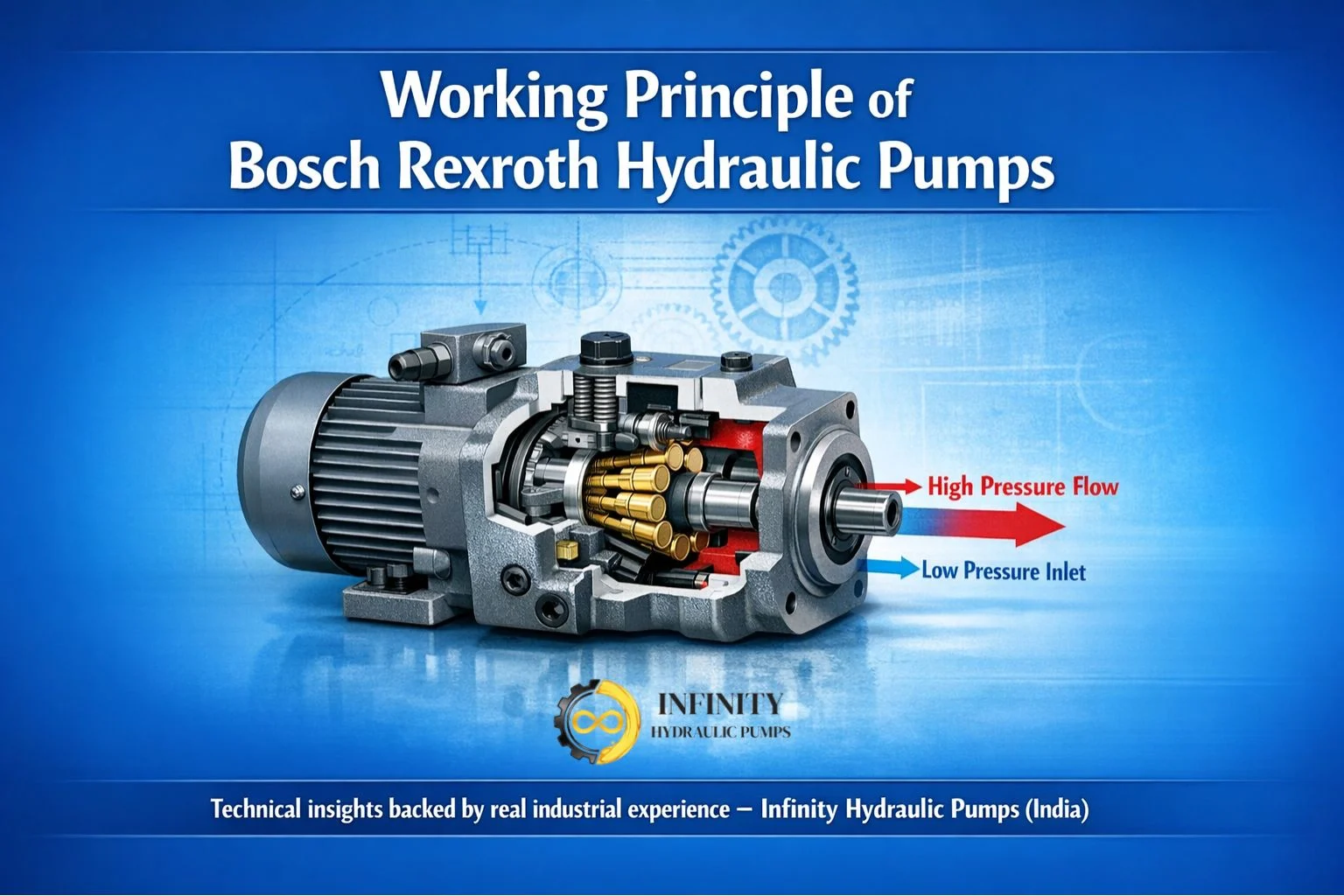
Hydraulic pumps are the heart of any hydraulic system. When machines demand smooth movement, stable pressure, and long working life, the working principle of the pump becomes critical. Bosch Rexroth hydraulic pumps are widely known for their engineering precision, but to truly understand their value, it is important to understand how they actually work inside a hydraulic system.
At Infinity Hydraulic Pumps, our engineers regularly work with Rexroth-based hydraulic systems used in Indian factories, machines, and power units. This article explains the working principle of Bosch Rexroth hydraulic pumps in a clear, practical way—without complex theory or marketing terms.
Basic Hydraulic Principle – Foundation of All Hydraulic Pumps

All hydraulic pumps, including Bosch Rexroth pumps, work on a simple physical rule:
Liquids do not compress easily.
When hydraulic oil is pushed into a closed system, the pressure created is transmitted equally in all directions. This principle allows machines to lift heavy loads, apply controlled force, and move smoothly.
A hydraulic pump does not create pressure by itself.
Instead, it:
- Moves oil from the reservoir
- Creates flow
- Pressure develops when that flow meets resistance in the system
Bosch Rexroth pumps are designed to control this flow accurately and efficiently, even under continuous industrial duty.
Construction of Bosch Rexroth Hydraulic Pumps
The working principle becomes clearer when we understand the internal construction.
A typical Bosch Rexroth hydraulic pump includes:
- Pump housing – Precision-machined body that maintains alignment and strength
- Rotating group – Pistons, vanes, or gears depending on pump type
- Drive shaft – Transfers mechanical power from motor or engine
- Control elements – Used in variable displacement and load-sensing systems
- Sealing and bearing system – Reduces leakage and improves service life
Bosch Rexroth focuses heavily on tight tolerances, surface finish, and balanced internal forces. This is one major reason these pumps perform consistently even in demanding Indian operating conditions such as high temperatures and long duty cycles.
How Oil Flow Is Generated Inside the Pump
The actual working process can be understood in simple steps:
- Suction Phase
As the pump shaft rotates, internal chambers increase in volume.
This creates a vacuum effect that pulls hydraulic oil from the tank into the pump. - Oil Trapping
The oil is temporarily trapped inside sealed chambers formed by pistons, vanes, or gear teeth. - Compression and Discharge
As rotation continues, chamber volume reduces.
The trapped oil is forced out through the outlet port into the hydraulic circuit.
This continuous cycle creates a steady oil flow, which allows cylinders and motors to work smoothly.
Pressure Generation – What Makes Rexroth Pumps Different
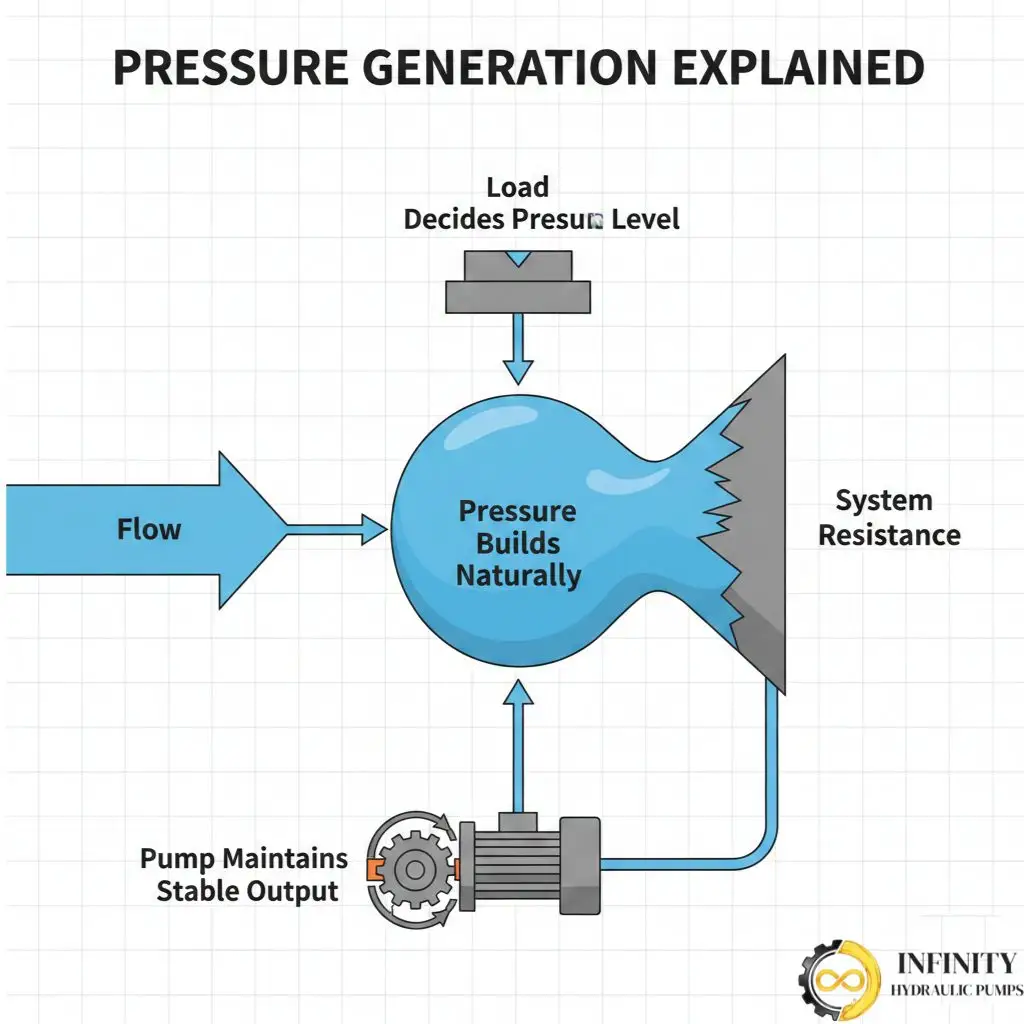
Pressure is created only when oil flow faces resistance, such as:
- Load on a hydraulic cylinder
- Restriction in a valve
- Demand from a hydraulic motor
Bosch Rexroth pumps are designed to:
- Maintain stable pressure under variable loads
- Reduce internal leakage at high pressure
- Adjust output automatically in advanced systems
In variable displacement pumps, the pump adjusts the oil flow based on system demand. This avoids unnecessary pressure buildup and reduces energy loss.
Efficiency Factors in Bosch Rexroth Hydraulic Pumps
Efficiency is where Rexroth engineering stands apart from generic pumps.
Key efficiency elements include:
- High volumetric efficiency
Minimal internal leakage ensures more useful oil flow - Mechanical efficiency
Reduced friction losses due to precision bearings and balanced components - Thermal efficiency
Less heat generation improves oil life and system reliability
At Infinity Hydraulic Pumps, we often see that machines using Rexroth pumps show lower oil temperature and longer maintenance intervals when correctly selected and installed.
Difference Between Bosch Rexroth Pumps and Generic Hydraulic Pumps
While the basic hydraulic principle remains the same, the difference lies in execution.
| Aspect | Bosch Rexroth Pumps | Generic Pumps |
|---|---|---|
| Internal tolerances | Extremely precise | Wider tolerances |
| Flow control | Smooth and stable | Often fluctuates |
| Energy usage | Optimised for efficiency | Higher power loss |
| Service life | Longer under continuous use | Shorter in heavy duty |
| Control integration | PLC & servo compatible | Limited control |
This is why Rexroth pumps are commonly used in automation lines, CNC machines, injection moulding machines, and heavy industrial power packs.
Role of Axial Piston Design in Rexroth Pumps

One of the most widely used Rexroth designs is the axial piston pump.
How it works:
- Pistons are arranged parallel to the drive shaft
- A swash plate controls piston stroke length
- Changing the swash plate angle changes oil flow
This design allows:
- Precise flow control
- Variable displacement
- High-pressure operation with smooth response
Our engineering team at Infinity Hydraulic Pumps regularly handles axial piston systems in plastic processing, steel plants, and automated machinery.
Servo and Load-Controlled Operation
Modern Bosch Rexroth pumps often work with:
- Servo valves
- Electronic controllers
- Load-sensing systems
This allows the pump to deliver only the oil required at that moment, improving:
- Energy savings
- Machine accuracy
- Component life
Such systems are especially useful in applications where load changes frequently, such as robotic systems and press machines.
Suggested Diagram Explanation (For Visual Section)
For better understanding, a diagram can show:
- Oil tank
- Pump inlet and outlet
- Rotating group (pistons or vanes)
- Direction of oil flow
- Load side resistance
This helps readers visualise how oil moves and where pressure develops inside the system.
Practical Insights from Infinity Hydraulic Pumps
Since 2020, Infinity Hydraulic Pumps, under the leadership of Akhil Sharma, has supported industries across India with genuine hydraulic components and technical guidance. With over 5 years of hands-on experience, our team understands not just the theory, but the real working behaviour of hydraulic pumps on factory floors.
Our engineers and technicians:
- Use modern diagnostic tools
- Work on vane, piston, and axial piston systems
- Help machine owners select pumps that match real operating conditions
- Support fast delivery from NCR for reduced downtime
This practical exposure allows us to recommend solutions that perform reliably, not just on paper.
Why Understanding the Working Principle Matters
Knowing how a Bosch Rexroth hydraulic pump works helps you:
- Choose the right pump type
- Avoid overloading the system
- Reduce oil heating issues
- Improve machine efficiency
- Increase component lifespan
A well-understood hydraulic system always performs better and costs less to maintain over time.
Final Thoughts
The working principle of Bosch Rexroth hydraulic pumps is based on simple hydraulic laws, but refined through advanced engineering, precision manufacturing, and intelligent control. This combination makes them suitable for demanding industrial environments across India.
When supported with correct selection, installation, and technical understanding—as practiced at Infinity Hydraulic Pumps—these pumps deliver consistent performance, energy efficiency, and long-term reliability.